Places of interest
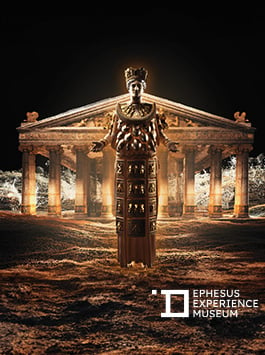
The Ephesus Museum, which is responsible for archaeological research, reorganization, supervision and protection on behalf of the Ministry of Culture, is one of the most important museums in Turkey not only with the works from Ephesus and nearby places belonging to Mycenaean, Archaic, Classic, Hellenistic, Roman, Byzantine,Seljuk and Ottoman periods, but also with cultural activities and capacity of visitors. Having been found as a storehouse after the excavations in Ephesus in 1929 and expanded with an additional building in 1964, The Ephesus Museum was improved by means of changes in exhibitions and new additions. Since The Ephesus Museum includes relics from a single antique city, the works are exhibited according to places where they were unearthed rather than a typical and chronological way of exhibition. To this end, exhibition halls are organized as Slope Houses and House Findings Room, The Section of Coins and Treasure, The Hall of The Funerary Relics, The Hall of Artemis, and The Hall of Imperial Cults. Besides these halls, many architectural works and sculptures are exhibited within the museum and the courtyards in harmonization with the garden decoration. Two Artemis sculptures, the bust of Eros, the statue of Eros with dolphin, the bust of Socrates are some of the worldwide known works exhibited in The Ephesus Museum. The Ephesus Museum possesses about 50.000 works in its collections. The number increases every year thanks to the ongoing archaeological excavations and donations from the local and neighbouring communities. In order to present these works to the service of scientific world and humanity sooner, 'The Hall of New Findings' has been found within The Ephesus Museum. However, this hall is not always enough for exhibiting numerous numbers of works. So, the other halls within the museum are needed to be renovated in the light of new findings according to modern museological principles. In accordance with this perception, groups of findings are being exhibited together after the last arrangements within The Hall of Slope Houses and House Findings so as to ensure the unity of theme. The hall includes many indispensable requirements in daily life from every century such as medical and cosmetic tools, jewels, weights, lighting tools; music and entertainment findings, examples to weaving tools; sculptures used in house cult and decoration, sculptures and busts of gods, goddesses and emperors, and furniture. One section within The Hall of Slope Houses is called 'Socrates Room' which is decorated with frescos, mosaics, and furniture as well as including dummies. New sections of The Ephesus Museum open to visitors upon recent arrangements the museum, Ephesus and Selçuk.
1st section: Arasta and Bath House Section is a adjacent to the courtyard, which is an integral part of the museum, exhibits commercial life in old Turkish towns, and various handicrafts that face extinction. This area can be found adjacent to the central garden of the museum. The department displays various stages of the cereal grinding process (mills), which played a significant part in agricultural local life as well as various types of copperware and beads produced to avert the evil eye. Within the section where Turkish tents are exhibited examples to old Turkish architecture and an Ottoman bath house dating back to 16th century are open to visitors.
2nd section: Ayasuluk Library is an old Turkish building (14th century) in the back street of The Ephesus Museum was restored by the museum, and it was designed as a small library where the public could read books and daily newspapers.
3rd section: The Museum for the Visually Impaired is situated in the Ephesus antique city, one of the restored shops in the lower Agora has been turned into a museum specific for the visually impaired. The museum consisting of two sections includes original and replica works of art. Cultural and Educational Activities Beyond its usual activities, The Ephesus Museum organizes cultural and educational activities for the public of the town and archaeological circles such as: Conferences Regular conferences are organized in which mostly the archaeology of Ephesus and nearby places is discussed. Exhibitions Modern works of art consisting of paintings, sculptures and various handicrafts are constantly exhibited in the arts gallery within The Ephesus Museum, which enables to build a bridge between antique and modern works of art, and also to convey a collection of modern works of art into the 21st century. Seminars The Ephesus Museum organizes annual meetings in order to protect the ancient works and seminars to educate students on Ephesus and ancient civilizations. In addition, trainings and excavation assessment meetings are occasionally held by the Ministry of Culture for museum experts from all around Turkey.
Note: Opened every day; in summer: 08:00-19:00 and in winter: 08:00-17:00 Addresss: Selçuk/Izmir Tel: +90 232 892 60 10
THE EAST GYMNASIUM
The East Gymnasium, one of the monumental structures of Ephesus, the gymnasium, is a complex that includes baths, palaestrae (exercise fields), study halls, and imperial cult rooms. According to an inscription it was built by famous sophist Flavius Damianus and his wife Vedia Phaedrina.
THE VARIUS BATHS
The Varius Baths were constructed in the 1st century B.C. During the excavations, parts of a bath and a roman latrine came to light. These structures next to the bath might belong to a gymnasium that may have been part of the complex.
THE MAGNESIAN GATE
This is the only city gate that survives up to the present day. There is not much thing to see today.
THE WATER SYSTEM AND NYMPHENIUM
The water springs are rather away from the fountains and houses in Ephesus. This monumental fountain on the street bounding the south side of the state was supplied by the Marnas River. The large fountain is well integrated into the street that fronts it. This monumental fountain was built between 4-14 A.D., and underwent various renovations the last of which was in the fourth century.
THE STATE AGORA
The state agora, measures 160 X 73 meters and was constructed in the 1st century A.D. It was the place the location of official religious and civic ceremonies, of government assemblies, and of the mercantile activities of the larger trading concerns that were subject to government regulation.
THE ODEION
This structure was devoted both to civic meetings and musical and theatrical performances. It seated 1400 people, and was constructed by Vedius Antonius and his wife Papiana in the second century A.D.
THE PRYTANEION
The Prytaneion (town hall ) was considered to be the sacred place of the city. It contained the altar of Hestia Boulaia, where a sacred fire burnt perpetually for centuries and was never extinguished. This the find spot of the two great statues of the Ephesian Artemis which are displayed at the museum now. The building was built in the 3rd century B.C during the reign of Lysimachos. The ruins seen today are dated to 1st century A.D. Two later temples near the site were dedicated to Emperor Julius Caesar and Dea Roma, the divine personification of the city of Rome.
THE WATER PALACE
It was built by proconsul Laecanius Bassus in 80 A.D., and is also called the “Water palace" because of its monumental appearance.
THE MEMMIUS MONUMENT
Memmius was one of the grandsons of Sulla, the famous Roman general. This monument dedicated to him was constructed in the first century A.D. during the reign of emperor August. A fountain was built into the northwest corner of the monument in the fourth century A.D.
THE TEMPLE OF DOMITIAN
Dedicated to Domitian, this is the first structure in Ephesus to be built in honour of a Roman emperor. The temple was erected on a terrace supported by a substructure measuring 50 by 100meters. The substructure of the temple is used as "Inscription Gallery" today.
THE POLLIO FOUNTAIN
This structure dedicated to C.Sextilius Pollio in 97 A.D. It was decorated by the statue group of Odysseus and Polyphemus, and a basin stood in front of it.
THE GATE OF HERCULES
Just before the Street of the Curetes stand the remains of ancient gate known as the Gate of Hercules. This name arises from the figures of Hercules on the western faces of the two extant pillars. The capitals of the columns were decorated with acanthus leaves. Presumably these pillars, along with four others were standing on the beam above the arch of the gate.
THE STREETS OF KOURETES
Owing to the fact that this street was used by a six-membered-class of civic priests, who were chosen anew each year, and played an important role in the management of the city, it was given “Kouretes Street. The porticoes flanked both sides of the street, which provided shade for pedestrian, and behind of which were located the various shops. The street was lined by statues of prominent Ephesians. After three severe earthquakes hit the city in the 4th century A.D. the street was restored. The main sewer system in Ephesus lies beneath this marble pavement of the street.
THE FOUNTAIN OF TRAJAN
It was dedicated to the emperor Trajan (98- 117), and constructed between 102-114 A.D. The two storied fountain had a colossal statue of Emperor Trajan in the middle.
THE SCOLASTICA BATHS
The first construction on this site dates to the first century, and was later connected to the brothel and the latrine. The three storied bath dates to 400A.D. comprises a various rooms for bathing and lounging along with a library and has a capacity of 1000.
THE LATRINE
The general toilets had a square pool in the middle surrounded on four sides by toilet seats, in front of which was a channel of running water. The floor of this place was covered with mosaics.
THE HADRIAN TEMPLE
The Hadrian Temple is one of the most impressive constructions in Ephesus. It was dedicated to the Emperor Hadrian (118-138 A.D.) The relief of Tyche, the goddess of city, is seen on the pediment of the temple. The legend about how Ephesus was established is also depicted on the friezes of the temple.
THE SLOPE HOUSES
These two or three storied houses belonged to the wealthy people of Ephesus were first built in the 1st century A.D. They were used as dwelling, with some renovations and repair until the seventh century. The walls were garnished with frescoes and the floors were decorated with mosaics.
THE BROTHEL
This two storied structure built during the reign of Emperor Trajan, forms a complex with the Scholastica Baths the latrines. The walls were decorated with frescoes and the floor was covered with mosaics.
THE LIBRARY OF CELSUS
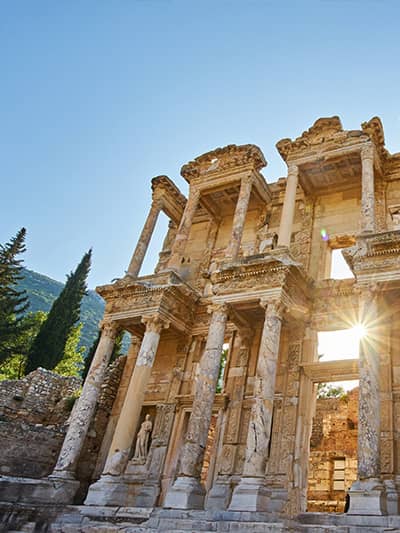
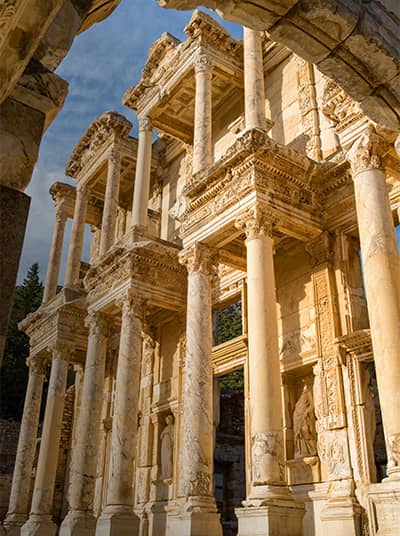
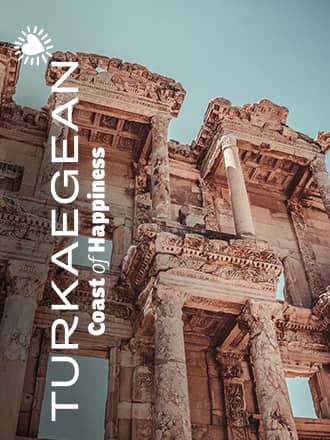
The Celsus Library was erected in A.D 135 by Julius Aquila for his father Julius Celsus Polemaeanus, the consul of Asia province of Roman Empire. The library, measuring 60.90 by 16.72 meters had a two storied facade and a large room inside. Its facade contains exemplars of architectural elements that are among the most beautiful ones of the period, such as doors, windows, gables, niches and columns. A gap of one meter between inner and outer walls of the the library protected the books from extremes of temperature and humidity. The sarcophagus of Celsus stand under the west side of the library. Four female statues standing between the columns personify the virtues of Celsus: Sophia (wisdom), Arete (virtue), Ennoia (intelligence), Episteme (knowledge). Celsus himself is buried in a sarcophagus beneath the west side of the library.
THE GATE OF MAZAEUS AND MITHRIDATES
This gate to the Agora was erected in 4-3 B.C by the freed slaves Mazaeus and Mithridates in honour of their former masters emperor Augustus and his family.
THE COMMERCIAL AGORA
The commercial agora , one of the significant centres in Ephesus was the real market place for trade in Ephesus. It was square and enclosed on all four sides by stoas. The agora was set up during the Hellenistic age and rebuilt during the reign of Emperor Nero and again in the 3rd century A.D.
THE TEMPLE OF SERAPIS
A path with a flight of stairs at the southwest corner of the Agora leads to the Temple of Serapis. The temple was rising on a high terrace .This prostyle temple had columns in the Corinthian order, each of which had a diameter of 1.5 meters and a total weight of 57 tons.
THE MARBLE ROAD
The sacred way that surrounds the Panayır Mountain is called the marble Street here, and is well preserved. The road was intended for vehicles, since pedestrians could use the colonnade. The huge sewer system of the city, which had a channel large enough to be entered by a human being also was running under this street.
THE GREAT THEATRE
It is situated on the slope of Mount Panayır. It was first built in the Hellenistic times and renovated in the 1st and 2nd centuries A.D. It seated 24.000 spectators. The stage building was three storied and rose to a height of 18 m. The cavea, the seating area, had consisted of three superimposed sections. The theatre was the scene of gladiatorial fights during the late Roman period.
During the early years of the Christianity, St.Paul who came to Ephesus to spread Christianty and he wanted to address to the crowd at the theatre. The silversmith Demetrius provoked the people against St. Paul because he earned a lot of many with his handmade Artemis statues and they shouted altogether “ Artemis of Ephesus is great, The greatest is Artemis”. So St.Paul was forced to leave Ephesus and he continued his journey to Macedonia.
THE ARKADIANE (HARBOUR) WAY
It was constructed in late Hellenistic period and renovated by the Emperor Arcadius (395 - 405) and known by his name. It is 500 m. in length and 11m. in width The shops were located on both sides of the Arkadiane way. It is also known as "Harbour Way"
THE THEATRE GYMNASIUM
This structure was built in the early period of the Roman Empire. Since it is situated next to the theatre it is also called "The Theatre Gymnasium" It is the largest gymnasium at Ephesus
THE HARBOUR GYMNASIUM AND BATHS:
There were two palaestras (athletic training grounds), one of which was 90 sq.m area and the other 200mx240m. The structure was built in the reigns of Emperors Domitian and Hadrian. The baths were erected in the second century. Since the baths were renovated in the 4th century they were also called “The Constantines Baths".
THE CHUCH OF VIRGIN MARY (THE CHURCH OF COUNCILS)
This church, one of the important edifices of Christianity, is the first church which was dedicated to Virgin Mary. The third meeting of the Ecumenical Council was held in this church in A.D 431.
THE STADIUM
The stadium measured 230mx30m and resembled a horse-shoe. The entrance was in its west facade. Seats for the spectators on the south side were constructed on the slopes of Mt.Pion while those on the north were built over a vaulted substructure .The first site of the stadium appears to go back to the Hellenistic period, and during the reign of the Emperor Nero (54-68 A.D.) it underwent transformation.
THE VEDIUS GYMNASIUM
The gymnasium, one of the preserved buildings to be found in Ephesus, was erected in A.D 150 by P.Vedius Antonius, one of the prominent wealthy Ephesians of the time and dedicated to the Emperor Pius and the goddess Artemis.