Map Of Turkey

Homepage | Ankara | Places of interest


«

Places of interest


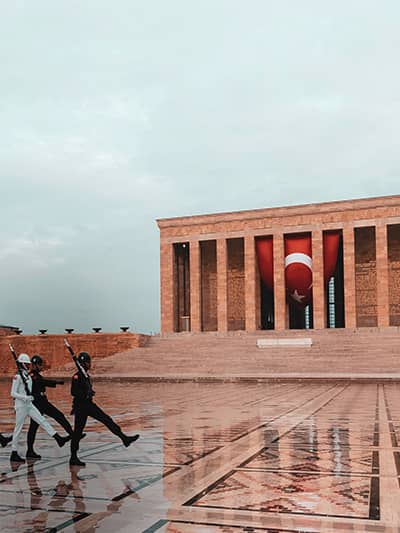
Anitkabir : The mausoleum of the Republic's founder and leader, Mustafa Kemal Ataturk, called Anitkabir and it was built on the hill of Rasattepe and has an impressive entrance. It was designed by architects Prof. Emin Onat and Doc. Orhan Arda, and completed in 1953. Ataturk was removed from the temporary burial site at the Ethnographic Museum and brought here with great ceremony on the same year. 

Within the Anitkabir complex there are: The Tower of Independence, The Tower of Liberty, The Road of Lions, Mudafaa-i Hukuk Tower, the Soldier's Tower, The Tower of Victory, The Tower of Peace, the April 23 Tower, The Misak-i Milli Tower, The Reform Tower and The Victory Reliefs. The hallowed Mausoleum hall itself is a colonnaded temple with huge bronze doors but little in the way of decoration. Opposite is the tomb of Ismet Inonu, the first prime minister of the Turkish republic and president after Ataturk's death. 

The Anitkabir museum is located between The Tower of the National Pact and The Tower of the Revolution. A number of Ataturk's personal belongings are exhibited, including clothes that he wore, and gifts presented to him by visiting foreign dignitaries. 

Museum Tel : (+90 312) 310 53 61 
Opening hours: Winter - 09:00-12:00 & 13:00-17:00. Summer - 09:00-12:30 & 13:30-17:00, but closed on Monday.


Anatolian Civilisations Museum: Located on the south side of Ankara Castle in the Atpazari area, the Museum consists of the old Ottoman Mahmut Pasa bazaar storage building, and the Kursunlu Han. Because of Ataturk's desire to establish a Hittite museum, the buildings were bought upon the suggestion of Hamit Zubeyir Kosay, who was then Culture Minister, to the National Education Minister, Saffet Arikan. After the remodelling and repairs were completed (1938 -1968), the building was opened to the public as the Ankara Archaeological Museum. 
Today Kursunlu Han, used as an administrative building, houses the work rooms, library, conference hall, laboratory and workshop. The old bazaar building houses the exhibits. Within this Ottoman building, the museum has a number of exhibits of Anatolian archeology. They start with the Paleolithic era, and continue chronologically through the Neolithic, Early Bronze, Assyrian Trading Colonies, Hittite, Phrygian and Urartu periods. There is also an extensive collection of artifacts from the excavations at Karain, Catalhoyuk, Hacilar, Canhasan, Beyce Sultan, Alacahoyuk, Alacahoyuk, Kultepe, Acemhoyuk, Bogazkoy Gordion, Pazarli, Altintepe, Adilcevaz and Patnos as well as examples of several periods. 
The exhibits of gold, silver, glass, marble and bronze works date back as far as the second half of the first millennium BC. The coin collections, with examples ranging from the first minted money to modern times, represent the museum's rare cultural treasures. 

Museum Tel : (+90 312) 324 31 60 / 312 62 48. 
Opening hours: 08:30 - 17:30, closed on Monday


Ethnographical Museum : This museum was founded in the Namazgah area of Ankara, on a hill with a Muslim graveyard, and was opened to the public on July 18, 1930. The courtyard was closed in November 1938 when it served as the temporary burial site for Ataturk, and reopened when his body was moved to Anitkabir. This section is still preserved as a tomb in symbolic respect of the memory of Atatürk, as the Museum served as his tomb for 15 years. 
The Ethnographical Museum has examples of Turkish art from the Selcuk period until the present day. There is a library for specialists in Anatolian ethnography, folklore and art history located in the museum. The building is rectangular with a single dome, and the stone walls covered with travertine.
The pediment is marble with ornate carvings, and a staircase of 28 steps lead to main entrance. There are three entrances to the building which has 4 columns. The column-lined inner court is reached by passing through a domed hall. A marble pool in the middle of the open courtyard is surrounded by a number of large and small rooms. The two-story administrative building is adjacent to the museum. 

Museum Tel : (+90 312) 311 95 56 

Opening hours: 08:30-12:30 & 13:30-17:30, closed on Monday


Museum of the War of Independence (1st Parliament Building):The building situated in Ulus Square housed the first Turkish National Parliament, from April 23 1920 to October 15 1924. It was later the headquarters of the People's Republic Party, and then the Law School. In 1952 it was turned over to the Ministry of Education and on April 23 1961 it was opened to the public as the Museum of the Turkish National Parliament. 
The building consists of the hall, the corridor, the Chambers of the Ruling Council, the Committee Room, the Break Room, the Administrative Rooms, the Parliamentary Meeting Hall, Office of Parliament Head, the storage for photographs and other items, and the basement which is used as an exhibition hall. 

Opening hours: 08:30 - 12:15, & 13:30 - 17:15, closed on Monday

State Art and Sculpture Museum, (near the Ethnography Museum). Hosts galleries with temporary exhibitions as well as a permanent display of Turkish art from late 1800s up to today.

Cer Modern. The recently-opened (Apr 2010) modern art museum of the city, Cer Modern is housed in the historic power plant building of Turkish Railways. Contemporary art.

TCDD Open Air Steam Locomotive Museum. An open-air museum.

Çengelhan Rahmi Koç Museum, is a similar to Istanbul's industrial museum (of which Çengelhan is actually a part), the technological progress from 1850s onwards is on display in this museum housed in an old Ottoman caravanserai. The museum contains various curios and collectibles including model trains to model sowing machines. It also contains a good collection of children toys and rooms hosting assorted technological collections such as cameras, diving equipment, telephones etc). Admission is 6 TL for adults.

Ankara Aviation Museum, Etimesgut (near highway to Istanbul). Various aircrafts, aviation items, missiles, and whatnot are in the exhibition, as well as a number of MiGs from the other side of Iron Curtain.


Thermal Springs:The most important thermal springs in the province are: Kizilcahamam-Sey, Ayas, Ayas Karakaya, Beypazari-Dutlu-Tahtali, Kapullu, Cubuk Meliksah, and Haymana.

  
Fortresses, Castles

Ankara Castle: The castle, which has guarded the city for centuries, is now a symbol of Ankara and its history is as old as the city itself. Although it is not exactly known when the castle was built, it is commonly believed to have been built by the Romans, then repaired and expanded by the Selcuks. It towers 110 meters above Bentdere Creek (Hatip Creek) which runs along its base. 

There are two parts, an inner and an outer castle, with over 20 towers. The outer castle encloses the old city of Ankara within its heart-shaped walls. The four-level inner castle is made partly of Ankara stone and partly of stones gathered from other structures. The two large gates of the inner castle are called the Outer Gate and the Castle Gate. The towers within the castle vary between 14-16 metres in height. Today within the castle walls there are a number of Ottoman-style houses dating as far back as the 17th century. 


Kalecik Castle: Kalecik Castle is 78 km from Ankara on the road to Cankiri, and is a strong landmark from the modern town as it was founded on a cone-shaped hill. It is connected to the mountains in the southwest by a ridge and sits high above the plain formed by the Kizilirmak (Red River).


Accommodation
  • Room :
  • Adult :
  • Child :
Flights
  • Roundtrip :One way :
  • Adult : Child (2-12) :
Tour
Transfer
  • Vehicle Type :
  • Vehicle Class Type :
  • Transmission Type :
  • Has Air Condition :
  • Mileage Charge Type :
Stories All Stories
  • Every Sunday, a brunch is being held in the ancient Byzantine Monastery in Gumusluk. The property is privately owned, andMore >>

  • Turkey is not a skiing destination, at least for now. But Europeans who love Turkey and skiing, or Turkish citizensMore >>
  • Information on some things to do when in Assos, one hour south of Troy (by car) Walks: Through the manyMore >>