Map Of Turkey

Homepage | Pamukkale (Hierapolis) | Places of interest


«

Places of interest


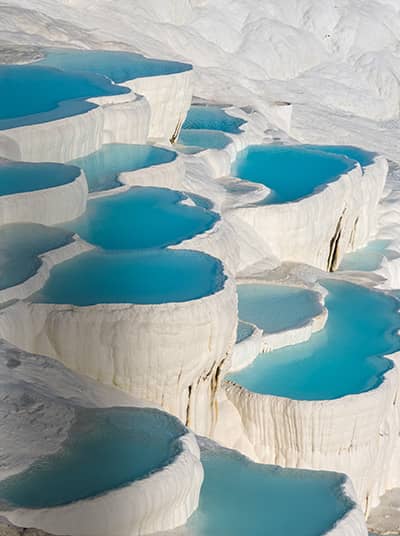
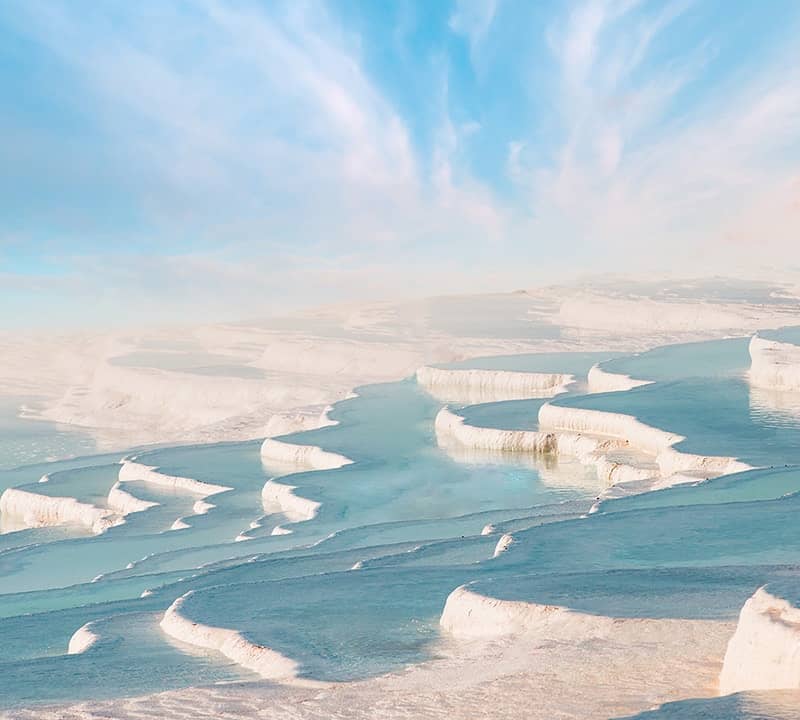
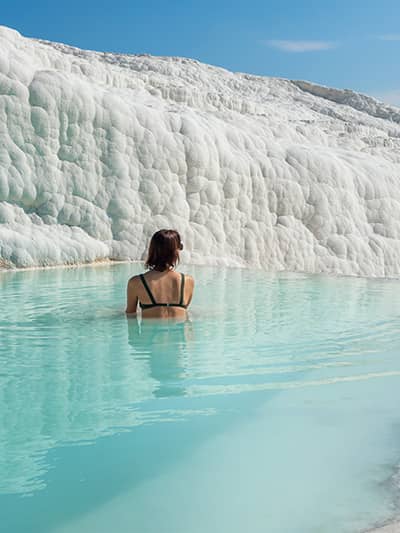
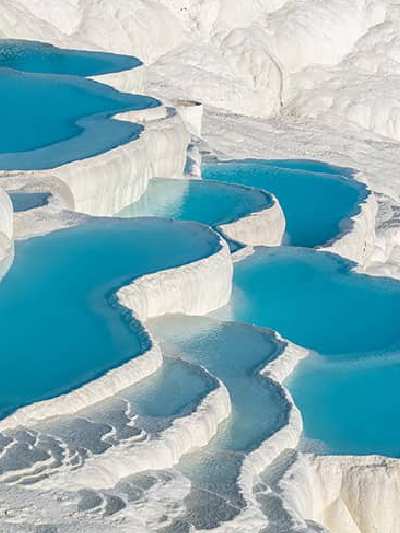
Before you arrive in Hierapolis, you can see the beautiful white travertine terraces of Pamukkale, located next to the ruins of Hierapolis. The extraordinary effect is created when water from the hot springs loses carbon dioxide as it flows down the slopes, leaving deposits of limestone. The layers of white calcium carbonate, built up in steps on the plateau, gave the site the name Pamukkale.
A good place to start your tour is the small but very interesting Pamukkale Museum, located near the parking area and housed in part of the south Roman baths (early seconnd century BC). The displays are presented attractively and include signs in English and Turkish. The collections include coins, jewelry, sarcophagi and architectural fragments among other items; the highlights are the statues and reliefs.

After the museum, there is a lot to see among the ruins of Hierapolis. Most of what you see here is from the Roman period, as the original Hellenistic city was destroyed by earthquakes in 17 AD and 60 AD. The site is surrounded by Byzantine walls, outside of which is an extensive necropolis.

Near the museum is a complex that includes the Sacred Pool, a colonnaded street, and a basilica church. The Sacred Pool is warmed by hot springs and littered with underwater fragments of ancient marble columns. Possibly associated with the Temple of Apollo, the pool provides visitors a rare opportunity to swim with antiquities! During the Roman period, columned porticoes surrounded the pool; earthquakes toppled them into the water where they lie today.

Behind the Sacred Pool is the nymphaeum, a monumental fountain that distributed water to Hierapolis. Dating from the fourth century AD, it has been partially restored. Three walls surround a basin of water, which was approached by steps on the open side. Statues filled the niches in the walls.

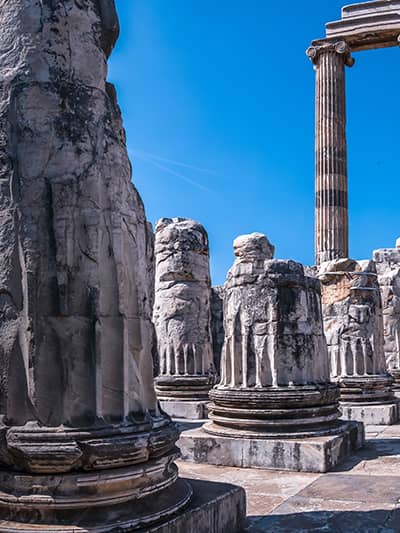
Next to the nymphaeum is the Temple of Apollo, patron god and divine founder of Hierapolis. All that remains are the foundations, platform and some entry steps; the foundations are Hellenistic and the rest is Roman (3rd century AD).

South of the Temple of Apollo is the Plutonium, a sacred cave believed to be an entrance to the underworld, the domain of Roman god Pluto (the Greek Hades). The cave emitted poisonous vapors in ancient times, and it still does! For this reason, the entrance is sealed off for the public.

East of the Temple of Apollo, toward the theater, are the ruins of a peristyle house with Ionic columns. Dating from the 6th century AD, it includes a courtyard with a floor made from polished stone (called the "opus sectile technique").

The theater of Hierapolis is well-preserved, especially the stage buildings, which were decorated with reliefs. Constructed around 200 BC, the theater could hold over 20.000 spectators and had reserved seating for distinguished spectators in the front row.

The main entrance of Hierapolis was a wide, colonnaded street called the Plateia, which ran from the Arch of Domitian to the south gate.

There is a ruined church across from the Martyrium near the Agora and another one built inside the baths on the other north side of the Agora.

The Martyrium of St. Philip, outside the walls by the northern part of the city, was built in the 5th century AD on the site of Philip's martyrdom. A square building with an octagonal rotunda, it measures 65 feet (20 m) per side. In the center was a crypt believed to contain the remains of Philip. The building seems not to have been used as a church nor as a burial site; it was probably set aside for processions and special services. Crosses and other Christian symbols can be seen carved over the arches.

To the west and south of the martyrium are the west necropolis and east necropolis, respectively. Another large necropolis is further to the north. Also near here is a small early theater, of which little remains.

Northwest of the theater are the north Roman baths, built around the late 2nd century AD and used as a Christian basilica in the 5th century.

To the north of the main ruins and along the modern road is the north necropolis, the largest in Anatolia. This graveyard contains more than 1,200 tombs of various types, including tumuli, sarcophagi and house-shaped tombs from the Hellenistic, Roman and early Christian periods. Some of them have Jewish inscriptions.

Nearby is the monumental Gate of Domitian, constructed around 83 AD to serve as the northern entrance to the city. It has three arches and two towers, and originally had two stories. The gate led into a colonnaded street known as Frontinus Street. This was the heart of the city during Roman times, containing shops and public buildings under covered walkways.

On the left of the gate is a large latrine. To the right of the gate is the tomb of Flavius Zeuxis, notable because of its inscription proclaiming that the Hierapolis merchant had traveled to Italy 72 times by sea.

East of the main street is the huge agora, the largest uncovered one discovered in the ancient world. It is 580 feet wide and 920 feet long and it was surrounded by Ionic columns. To the agora's east and up a flight of steps was a large stoa-basilica. This was once richly decorated with popular ancient motifs including sphinxes, lions, bulls, garlands, Eros figures and Gorgon masks.

On the southwest side of the agora is a Byzantine Gate, part of the early 5th-century Byzantine wall that protected the city from invaders. Between the Byzantine Gate and the parking area, near the museum, are the remains of another 5th century Christian basilica.


Accommodation
  • Room :
  • Adult :
  • Child :
Flights
  • Roundtrip :One way :
  • Adult : Child (2-12) :
Tour
Transfer
  • Vehicle Type :
  • Vehicle Class Type :
  • Transmission Type :
  • Has Air Condition :
  • Mileage Charge Type :
Stories All Stories
  • Every Sunday, a brunch is being held in the ancient Byzantine Monastery in Gumusluk. The property is privately owned, andMore >>

  • Turkey is not a skiing destination, at least for now. But Europeans who love Turkey and skiing, or Turkish citizensMore >>
  • Information on some things to do when in Assos, one hour south of Troy (by car) Walks: Through the manyMore >>